>>View Focus Group Questions
>>View Focus Group Findings (note form, excuse grammar)
We asked these questions to two focus groups we conducted and audio recorded. The reason for having two groups is that it made each group smaller and people would feel more comfortable than being in one large group.
The group had seen three advertisements. One was a Heart FM Advert which was on around lunchtime which fits in with its target audience of middle aged women. The Capital Radio advert the three people had seen was of an evening time. The BBC Radio 1 advert was broadcast within the BBC network on an awards show.
Some similarities that all the videos had were that they all had famous figures in them, Heart focused on showing some musicians and presenters. Capital focused only on famous musicians. BBC Radio 1 only shown their presenters to shows. I think that this reflects what the station are in the figures they chose for the videos. Heart FM have some personality presenters and it would seem they want to promote this, but as they don't always have presenters that mostly speak, they have put some musicians in to the advertisement to show the style of music. Capital have recently opened up to the Midlands area, taking over Galaxy and their listeners really just want music thus their choice to have musicians in the commercial. BBC Radio 1 is quite different as this was an internal promotion, I think they will have chosen to use presenters not only because they all have personality and speak a lot on their shows but because this is in the contracts with the presenters and would mean the BBC do not have to pay any other parties for the commercial.
We asked what was/is the favourite advert of all the participants in the focus group. The majority of the group said the Fosters advert was there favourite advertisement with the australian characters taking phone calls. Some group members said the Barclay-card advert with the man on the slide making his way home from work and how his Barclay-card has helped him to get the simpler things done faster. Both of these adverts I feel would be targetted towards young adults between 18 and 28.
With the Fosters advert the group said that they wouldn't choose the product because of the advertisement, however, most group members were below the age of eighteen and wouldn't be able to buy this product under UK law and this would have been something that the producers of this advert would have in mind.
The same result was with the Barclay-card advert, group members said that the advert appealed to them if they were to make a decision because of the wireless processing the card used, but, they would not use this advert to decide on something financial like moving banks, starting a new account etc.
The radio stations that were most listened to in the group included Capital Radio (Midlands), BBC Radio 1 and Absolute Radio. Only one person chosen Absolute and Radio 1 where the rest of the group chose Radio 1.
Everybody besides one person in the group who listen to radio 1 listened for the presenters, not the music.
We asked how the group members discovered this radio station and not a single person said that they started listening to the radio station through advertisements, rather through word of mouth and pre-tuned stations picked up by default scans on devices.
The focus group taught the group a lot about how people find out about their radio stations of choice and how they are advertised to coincide with this. Something that we came across was that the televisiona dvertisements had no effct upon listeners in our focus group and that people found out about their favourite radio station through word of mouth or because the station was readily available.
From thos findings, one may think, why have a television advertisement if they are not immediately effective? Well, that question is false and television advertisements can still have a huge impact, even from our focus group findings, if they are done right! We feel that we need to promote how Academy Radio is accesible from anywhere, not just when in Park Hall Academy, as well as this we need to make sure that people will talk about the advertisement which in-turn will drive publicity towards Academy Radio.
The way we can play on the readiness of the station is to promote the listening of the web, through the Academy's Virtual learning Environment. However, this is useless if we don't establish the brand of Academy Radio and get people talking about the station. To maximize word of mouth publicity, we will need to make our advertisement go viral. If we make an advertisement that is suited to our target audience of secondary school students aged between 11 to 18 who are currently in education, then we need to make sure that the advertisement will be relevant to them and will get them all speaking about Academy Radio.
The difference between Academy Radio and the radio stations spoken about in the focus group session is that Academy radio isn't yet an established brand. We will need to make sure that we can use the Academy's image correctly and can make sure that the advertisement is branded with what Academy Radio currently has in place for branding to not alienize people.
0
comments


The Electric Theatre, Britains oldest working cinema: The last projectionist
20:16
Today the Media Department ran a trip to visit The Electric Cinema which is the oldest working cinema in the United Kingdom.
We watched a film in the second screen on the first floor, called The last Projectionist which is a film about the cinema itself. After this we watched the film we went to the first screen on the ground floor for a Q&A session with the man behind the film; Tom Lawes.
The film told a tale about the history of cinema and how it has changed over the years. We heard about news reels and news cinemas which linked with my radio technology unit covered with Mr Crawford. A theme which was strongly covered in the film was how multiplex cinemas really dominate the industry but as well how independent cinemas can still thrive and sometimes benefit over potential changes to the industry which would affect multiplex cinemas.
Another main topic in the film was about the introduction of new technologies where we learnt about how cinemas are becoming digital and projectors are becoming less used. We was able to link this topic of the film with the Q&A session afterwards where the producer of the film, also the owner of The Electric Cinema had told us about his plans to add a digital projector to the first screen and spoken about why the second screen was digital.
The film itself spoken about how different projectionists felt about the introduction of digital projectors rather than 35mm negative projectors. From this topic in the film I noticed how the older generation are less in-favour of change and would prefer things to stay how they are, where younger projectionists and new-comers can see the benefits to not only the quality of digital screens but also in storage, transportation and costs.
Some of the benefits I found that digital screens may have include:


We watched a film in the second screen on the first floor, called The last Projectionist which is a film about the cinema itself. After this we watched the film we went to the first screen on the ground floor for a Q&A session with the man behind the film; Tom Lawes.
The film told a tale about the history of cinema and how it has changed over the years. We heard about news reels and news cinemas which linked with my radio technology unit covered with Mr Crawford. A theme which was strongly covered in the film was how multiplex cinemas really dominate the industry but as well how independent cinemas can still thrive and sometimes benefit over potential changes to the industry which would affect multiplex cinemas.
Another main topic in the film was about the introduction of new technologies where we learnt about how cinemas are becoming digital and projectors are becoming less used. We was able to link this topic of the film with the Q&A session afterwards where the producer of the film, also the owner of The Electric Cinema had told us about his plans to add a digital projector to the first screen and spoken about why the second screen was digital.
The film itself spoken about how different projectionists felt about the introduction of digital projectors rather than 35mm negative projectors. From this topic in the film I noticed how the older generation are less in-favour of change and would prefer things to stay how they are, where younger projectionists and new-comers can see the benefits to not only the quality of digital screens but also in storage, transportation and costs.
Some of the benefits I found that digital screens may have include:
- Storage of Media
Using 35mm projectors mean the film has to be bought in reels, this is very costly. Digital projectors use a hard drive to store the media and are about the size of a book. - Cost
In transport the cost is significantly cut as the media is smaller. The cost of the film itself in terms of the media used to show the film would be a lot lower, rather than relying on printing the film. - Training
This was discussed in the Q&A session with Tom Lawes, he said that training somebody to use a digital projector would take about thirty minutes, where as it would take about three weeks to train somebody to use a 35mm projector correctly. - Viewing
Whilst some older projectionists said that the quality is better on 35mm, most projectionists say that digital is much better, including Tom Lawes in the Q&A.
The idea of keeping 35mm is becoming more of a nostalgic thing as everybody reacts to change in different ways. Personally, I see this change as evolution and it is things like this that make the entertainment film industry better for everybody.
A subject covered in the Q&A session was the effects of film in our immediate local area. IMAX, Birmingha, we found out no longer exists. This was added to the film in April and shortly after this the IMAX cinema turned in to a usual cinema as the costs if running under the IMAX title as well as the film costs were too much.
I really enjoyed the film and I liked being able to see how film has changed so drastically, especially in the immediate are of where I live. It was interesting to see where the cinema entertainment industry was going, and with our Academy being the first group of students to see the film was excellent, especially that we had a Q&A with the producer of the film, in his own cinema.


PR & Marketing: Fundraising
13:07
In the media department we are going to start fundraising to buy a new professional video camera and microphone boom. Whilst the Academy has agreed to supply some funding, we want to earn some money too for the equipment.
The class has put together a fundraising committee and I am a member of this. I have thought up a few ideas I think we could put in to action to begin fundraising:
The class has put together a fundraising committee and I am a member of this. I have thought up a few ideas I think we could put in to action to begin fundraising:
- Audio advertisement creation for Academy Radio - As well as airing the adverts, this would be some marketing material an organisation or company could use.
- Graphic advertisement creation for Academy Radio website - As well as publishing the adverts, this would be some marketing material an organisation or company could use.
- Auction - We could ask local companies, famous people, teachers could all donate something unique to be auctioned at a school event. This could even be themed.
- Sponsored spelling bee - Hold a spelling bee, this could be sponsored and each student could be sponsored.
- DJ 100 - Act as a promotional drive for Academy Radio, try and get as many DJ's as possible on Academy Radio, live, atleast once through the day.
- Auction of promises - The same as the auction theme but all of the things being auctioned are from local businesses, such as a free makeover at a Salon, or a free meal at a restaurant etc. This would work well as it would promote local business and at almost no cost to the people offering the prizes.
Corporate & Promotional Videos
12:22
What is a corporate video?
Corporate videos are videos which are used within a corporation, this can include material such as training videos, employee expectation videos or videos promoting what the company do. These basically engage the company with the public, either before joining or participating in some activity with the company, or to get press attention for the company.
A company who might use a corporate video would be a charity to demonstrate the best parts of what they do.
A company who make promotional videos often is Apple, at the end of their keynote speeches after thay have introduced a new product.
Some examples of promotional videos:
What is a promotional video?
Promotional videos are a sales video which are used to introduce a new product or service to an audience. They are longer than commercials, around ten or fifteen minutes and promote what a product or service is. It is not directly selling the item, rather driving up attention about the product to in turn, make the public excited about a product and usually used in keynote speeches to sum up after an event.
Above is a video Apple have made for their MacBook Air product. This was shown at the end of the keynote speech by Steve Jobs, this sums up all of the best parts of the product. The message being promoted in this is the simplicity of the Macbook Air and how it can make your life easier and more productive at the same time. This is a promotional video for the Macbook Air, by Apple.
The style of this video is very minimalist which is great for making the product stand out. The sound is clear and uses a lot of buzz words, such as 'powerful' and 'compromise'. The lighting is carefully considered in each scene and makes sure that the product looks glorius. There's a lot of emphasis on how thin the device is so there are lots of shots at the side of the device. In my project I would like to use the simplicity of the device.
This video is for the HTC Desire Z. It is a corporate video made by HTC promoting the features of this mobile phone. The message being promoted here is how the HTC Desire Z can keep you more connected and organized; the device can centralize your daily routine. This video could be seen by customers interested in knwoing more about the product whilst being a great resort for retailers learning about the product.
In this video we don't see a narrator on the screen, instead all of the focus is on the product. We see lots of dynamic views of the phone and they're made very clear. These views look to be animated and made from designs of the product on a computer as we don't see anybody real using the device, just computer animations of specific things, in-time with the narration. I think it works very good for the device as if somebodys hand was to be in front of the device then the viewers view will be obstructed.
This video is a walkthrough corporate video of how Google's operating system for netbooks works and is safe. The video bases itself around the USP of keeping the device safe. The message being promoted here is how secure the Chrome Operating System is for computers and laptops.
This video is made with the narrator on screen in front of a green screen where behind him an animation has been added and he has been pushed to the bottom right of the screen. This works well for corporate videos that are trying to educate users as natural instinct in the western world is to read from the left, so when important things appear on screen, they always appear from the left. I feel the target audience of this video would be people with a keen interest in technologies and may understand some things in this video more than others. I don't think the narrators voice is as clear as the other videos and I found myself mishearing things in the classroom using earphones so the video requires some level of attention. Something I like in this video is the animation with the narrator on the bottom right and if we need to use narration I would like to incorporate this with the green screen we have in the Media Department at Park Hall Academy.
Promotional videos are great for promoting a product more visually and getting product specific information out to a wider audience using the power of the internet to distribute this.
This is a corporate video introducing CashSender. This company deals with online payments and are a gateway between a customers bank account to a businesses bank account. The USP of this is low transfer fees which they boast about in the video. This video is promoting how you can benefit from using CashSender as your payment gateway for online stores and consumers, its main emphasis is on price and how they can help small and medium sized businesses.
This video focuses on the problems of three family members selling items online. They concentrate on how they beat the competition in letting the characters in the video keep more money. Like the HTC video, we don't see a narrator on screen. Everything in this video is very easy to follow and is said with a lot of simplicity. The animations are a great guide incase you can't hear the audio for some reason and you could tell what most of the audio is through these animations.
This is a corporate video for the University of Roehampton in London. The video is promoting how the University works and would be placed online for people interested in applying to study at the University as well as being shown at presentations and open days.
I feel that the video is great for promoting the university and its use of sped-up shots used in cut-aways and the gliding shots demonstrating space are things I would like to use in my promotional video. I like how the video starts with the phrase 'Open Spaces. Open Minds.' This is something I would definitely like to include in my project as I think it is excellent for keeping to the topic and is really effective to an audience in leaving that message with them.
View Risk Assessment
View Meeting Notes
View Creating a Visual Impact
Corporate videos are videos which are used within a corporation, this can include material such as training videos, employee expectation videos or videos promoting what the company do. These basically engage the company with the public, either before joining or participating in some activity with the company, or to get press attention for the company.
A company who might use a corporate video would be a charity to demonstrate the best parts of what they do.
A company who make promotional videos often is Apple, at the end of their keynote speeches after thay have introduced a new product.
Some examples of promotional videos:
What is a promotional video?
Promotional videos are a sales video which are used to introduce a new product or service to an audience. They are longer than commercials, around ten or fifteen minutes and promote what a product or service is. It is not directly selling the item, rather driving up attention about the product to in turn, make the public excited about a product and usually used in keynote speeches to sum up after an event.
Above is a video Apple have made for their MacBook Air product. This was shown at the end of the keynote speech by Steve Jobs, this sums up all of the best parts of the product. The message being promoted in this is the simplicity of the Macbook Air and how it can make your life easier and more productive at the same time. This is a promotional video for the Macbook Air, by Apple.
The style of this video is very minimalist which is great for making the product stand out. The sound is clear and uses a lot of buzz words, such as 'powerful' and 'compromise'. The lighting is carefully considered in each scene and makes sure that the product looks glorius. There's a lot of emphasis on how thin the device is so there are lots of shots at the side of the device. In my project I would like to use the simplicity of the device.
This video is for the HTC Desire Z. It is a corporate video made by HTC promoting the features of this mobile phone. The message being promoted here is how the HTC Desire Z can keep you more connected and organized; the device can centralize your daily routine. This video could be seen by customers interested in knwoing more about the product whilst being a great resort for retailers learning about the product.
In this video we don't see a narrator on the screen, instead all of the focus is on the product. We see lots of dynamic views of the phone and they're made very clear. These views look to be animated and made from designs of the product on a computer as we don't see anybody real using the device, just computer animations of specific things, in-time with the narration. I think it works very good for the device as if somebodys hand was to be in front of the device then the viewers view will be obstructed.
This video is a walkthrough corporate video of how Google's operating system for netbooks works and is safe. The video bases itself around the USP of keeping the device safe. The message being promoted here is how secure the Chrome Operating System is for computers and laptops.
This video is made with the narrator on screen in front of a green screen where behind him an animation has been added and he has been pushed to the bottom right of the screen. This works well for corporate videos that are trying to educate users as natural instinct in the western world is to read from the left, so when important things appear on screen, they always appear from the left. I feel the target audience of this video would be people with a keen interest in technologies and may understand some things in this video more than others. I don't think the narrators voice is as clear as the other videos and I found myself mishearing things in the classroom using earphones so the video requires some level of attention. Something I like in this video is the animation with the narrator on the bottom right and if we need to use narration I would like to incorporate this with the green screen we have in the Media Department at Park Hall Academy.
Promotional videos are great for promoting a product more visually and getting product specific information out to a wider audience using the power of the internet to distribute this.
This is a corporate video introducing CashSender. This company deals with online payments and are a gateway between a customers bank account to a businesses bank account. The USP of this is low transfer fees which they boast about in the video. This video is promoting how you can benefit from using CashSender as your payment gateway for online stores and consumers, its main emphasis is on price and how they can help small and medium sized businesses.
This video focuses on the problems of three family members selling items online. They concentrate on how they beat the competition in letting the characters in the video keep more money. Like the HTC video, we don't see a narrator on screen. Everything in this video is very easy to follow and is said with a lot of simplicity. The animations are a great guide incase you can't hear the audio for some reason and you could tell what most of the audio is through these animations.
This is a corporate video for the University of Roehampton in London. The video is promoting how the University works and would be placed online for people interested in applying to study at the University as well as being shown at presentations and open days.
I feel that the video is great for promoting the university and its use of sped-up shots used in cut-aways and the gliding shots demonstrating space are things I would like to use in my promotional video. I like how the video starts with the phrase 'Open Spaces. Open Minds.' This is something I would definitely like to include in my project as I think it is excellent for keeping to the topic and is really effective to an audience in leaving that message with them.
Legal and Ethical issues
We need to make sure that the production is within the law and appeals to all manner of people without causing offence. Some issues which may arise include:
- Defamation LawsWhen filming for a promotional video, everybody should be represented in good light and as a result of the video, nobody should be put across in a bad way.
- SecretsIf any sensitive information is heard by any of the production members then we will deal with these in a confidential manner and will comply with the National Secrets Act 1989.
- CopyrightWe will be respecting copyright laws held in the UK as this is where the video will be displayed. We will use either original content or obtain content to which we have rights and author permission to use. We will comply with this by using open source fonts for branding, obtaining or creating background footage used in chroma key in a fair, lawful manner and any soundtracks we will respect the authors rights to how that is used.
- DiscriminationAs it is illegal to discriminate against anyone on grounds of sex, age, disability or ethnic origin
when recruiting or in the workplace we will make sure we do not cause offence when casting and participants in the video shall be chosen by staff in the department to represent the Science Department, we expect this shall be judged on the knowledge, availability and how outgoing the students are. - Representational IssuesWe will make sure we use morals and justify what is right and wrong in the production. We will make sure the Science Department is seen in a good light and that we do not portray the department or Park Hall Academy as something it is not.
View Risk Assessment
View Meeting Notes
View Creating a Visual Impact
Higher Education
12:12
In my group we were tasked with promoting taking a gap year after Sixth Form. This year is more important than other years because if students want to go to University then they will have to pay the higher fees.
The class are researching Universities, apprenticeships, jobs and gap years. All of this will be made in to a display board at the back of the classroom to promote what opportunities BTEC National Media Students can do after completing the course. The board should be ready before Sixth Form open evening.
In my group, my role was to find actual gap years which are relevant to the course and can help make you stand out from the average media student when applying to universities or jobs. I found Gap Year 365 to be a very interesting website with lots of great gap years open which people could sign up to from them.
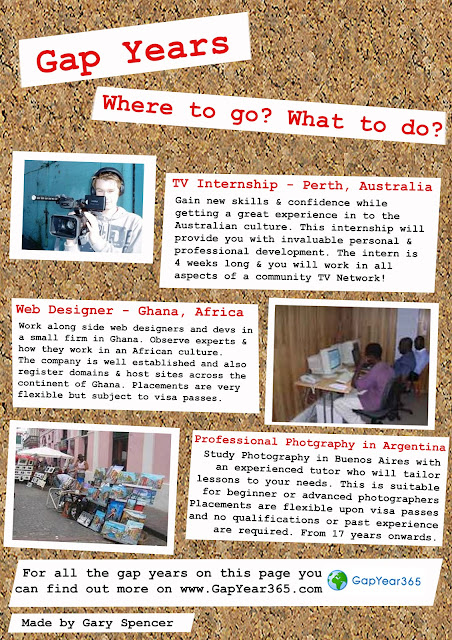
I studied three different gap year placements which I felt were relevant to the creative media national course. These were:
The class are researching Universities, apprenticeships, jobs and gap years. All of this will be made in to a display board at the back of the classroom to promote what opportunities BTEC National Media Students can do after completing the course. The board should be ready before Sixth Form open evening.
In my group, my role was to find actual gap years which are relevant to the course and can help make you stand out from the average media student when applying to universities or jobs. I found Gap Year 365 to be a very interesting website with lots of great gap years open which people could sign up to from them.
I studied three different gap year placements which I felt were relevant to the creative media national course. These were:
- TV Internship - Perth, Australia
This internship covered an area of topics in a community television station, tasks such as administration, fundraising and public relations to media content such as production, editing, scriptwriting, research crew and came with the opportunity of joining the production crews when they are producing content. More on this Gap Year here. - Web Designer - Ghana, Africa
This placement was with a professional design firm in Ghana. Accomodation on the visit would be in either a guest house but was most likely to be with a host family where you would live with a family, perhaps a family whom are to do with the design firm for a real experience of life in Ghana. This placement had the ability to teach new skills such as web technologies and how hardware worked, but more media related topics too such as user experiences when on websites to finding content for the websites to use. More on this Gap Year here. - Photography - Argentina
This placement was set-up with professional photography tutors in Argentina. The skill level was not an issue as the tutors could teach from beginners to advanced. Argentina has a lot of nice natural landscapes and wildlife and this was a great opportunity for anybody wanting to take up a profession in photography. More on this Gap Year here.

The aim for this is that the poster would appeal and stand out on the display board so that students would be interested in either taking the course and a gap year for Sixth Form, or current students would be interested in taking a gap year after studying this course in Sixth Form.
Our group succesfully completed our work for the display board, we felt to a professional standard and we included some interaction with the products we created in our group of three. Daniel created a suitcase which could be opened when placed on the board and shown the stuff that you should take with you with the costs of some of these things, Danielle created a passport which you could open and had some important information about gap years as well as some finance information in there.
I think that our group worked really well on this subject and I feel that we have advertised taking a gap year succesfully as a whole class I feel we have done great in showing potential Media National students the wide range of options open to students after completing the course.
I think that our group worked really well on this subject and I feel that we have advertised taking a gap year succesfully as a whole class I feel we have done great in showing potential Media National students the wide range of options open to students after completing the course.
Subscribe to:
Posts (Atom)